
Sushi for Robots: A Programming Gauntlet, Not Your Average Cooking Puzzler
3.5/5 Overall Score
At In Game News, we’ve reviewed countless puzzle titles over our two decades in the industry. So, when Mameshiba Games dropped Sushi for Robots on October 23, 2025, our initial expectation, much like many players, was for a breezy, food-themed puzzler. We were, however, profoundly mistaken. This isn't a casual romp; it's a dense, challenging programming exercise cleverly disguised in a charming Japanese woodblock art style. It will either delight your inner engineer or push your patience to its absolute limit, settling into a niche that will undoubtedly prove polarizing.
Beyond the Menu: A Logic Circuit, Not a Kitchen
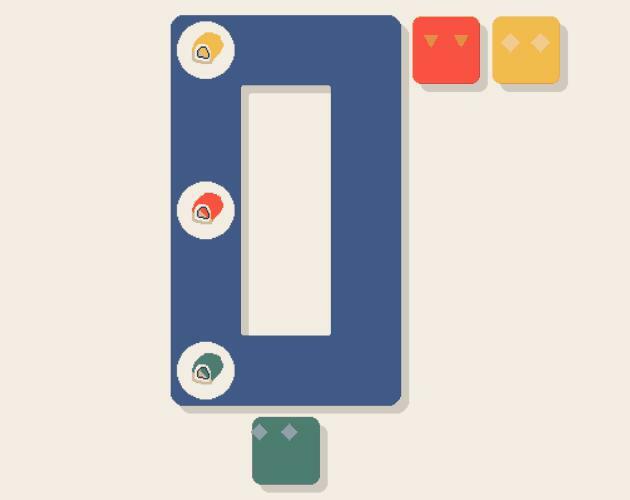
Forget the frenetic chaos of an Overcooked! kitchen or the strategic placement of a Diner Dash setup. Sushi for Robots is a different beast entirely, aligning more with the meticulous planning and system optimization found in games like Factorio or Satisfactory. The core loop is deceptively simple: deliver specific colors of sushi to matching robot customers via a clockwise conveyor belt system, all within a finite turn limit. But where the brilliance, and the frustration, truly begin is in the tools at your disposal.
The Gates to Advanced Algorithmic Thinking
Your "toolbox" isn't a set of knives and pans; it's a collection of gates, each with unique effects on the sushi stream. Mastering their nuanced interactions is critical. For the first ten levels, the game eases you in, letting you grapple with basic mechanics. Then, as any veteran gamer can attest, the difficulty curve spikes dramatically, transforming into what we'd call "wasabi hot."
- Colour Gates: Straightforward. Sushi passing through changes to the gate's color. Simple, until you need to color-coordinate multiple items.
- Junction Gates: Redirect sushi, enabling bypasses of conveyor sections. Essential for optimal pathing.
- Portal Gates: Teleport sushi to a linked portal. These introduce complex spatial reasoning, making you rethink entire layouts.
- Break Gates: Destroy other gates after use. This adds a temporal layer, forcing you to consider gate longevity and sequence.
- Swap Gates: Flip other gates around once sushi passes. This is where the game's complexity truly blossoms, introducing dynamic, turn-based modifications to your carefully constructed circuits.
Innovation Meets Intricacy: A Programmer's Dream, A Puzzler's Nightmare?
We're rarely genuinely surprised by innovation in the puzzle genre anymore; too often, we see rehashes of Sokoban, sliding puzzles, or worn-out jigsaws. Mameshiba Games, however, deserves credit for crafting something genuinely unique. The fusion of coding logic with this delightful sushi aesthetic is both cunning and superbly designed. With 80 distinct puzzles across four "seasons," each challenging a different facet of spatial and logical reasoning, the game offers immense content for those willing to dive deep.
Yet, for many of us on the editorial team, the prevailing sentiment after completing Sushi for Robots was one of sheer exhaustion. This isn't a game you brute-force; every gate placement, every sushi movement, demands meticulous planning. The sheer number of permutations, especially with the dynamic Break and Swap Gates, escalates exponentially. We found ourselves staring at the same screen for thirty minutes or more, only to discover a fundamental flaw in our logic path.
Perhaps the most challenging design choice is the game's steadfast refusal to hold your hand. There's no hint system, no gently nudging QoL features. Furthermore, the game operates at the fringes of its own rules, presenting subtle exceptions that require significant trial-and-error to learn—for example, a Swap Gate's ability to move a Colour Gate directly onto a robot, a placement initially forbidden. This lack of guidance, while empowering for dedicated puzzle fiends, acts as a significant gatekeeper for the casual player.
The Verdict: A Specialized Palate Required
Our analysis indicates that Sushi for Robots will be a defining title for a specific subset of players. Those who revel in Mensa-level challenges, who approach problems with a methodical, programmer's mindset focused on logic flows and sequence optimization, will find a deeply satisfying experience here. It's a proper brain-tickler that exquisitely repackages sequencing problems.
However, for gamers who prefer a more intuitive or forgiving puzzle experience, or those who find prolonged periods of head-scratching more frustrating than rewarding, Sushi for Robots will test their patience severely. It's a testament to its innovation and depth, but also a warning about its unforgiving difficulty. If you're ready for a coding crunch, dive in. If not, you might find yourself cursing its intricacy rather than savoring its cleverness.
Key Takeaways:
- Release Date: October 23, 2025
- Price: £4.69
- Formats: Xbox Series X|S (reviewed), Xbox One
- Availability: Not on Game Pass Day One, Not Xbox Play Anywhere Enabled
Pros:
- Gorgeous woodblock art style.
- Hugely innovative blend of coding logic and puzzle mechanics.
- Dense with 80 unique, challenging puzzles.
Cons:
- Incredibly dense and difficult, especially after the initial levels.
- Requires a programmer's or deeply logical mindset.
- Frustrating design exceptions and lack of hint system increase the learning curve.