
Geareo Aims to Fix Gaming’s 'Clockwork' Physics
Most games that feature "clockwork" components are lying to you. Usually, they are nothing more than brass-edged cubes with a decal of a moving gear, tied to a line of code that simply reads "MOTOR POWER = YES." It is a mockery of physics that treats kinetic energy as an afterthought. Enter Geareo, a new freeform sandbox builder from developer Witweld that aims to set the world to rights, one perpendicular crown wheel at a time.
Defined by its commitment to the spectacle of real gears that transmit motion and force without slipping, Geareo offers a mechanical playground for the PC. Whether you are building for the sheer hell of it or attempting to complete specific challenges—like driving over a cattlegrid without performing an accidental backward somersault—the game demands a genuine understanding of how your creations function.
Physics Without the Frustration
While Geareo is largely naturalistic, it does make one significant concession to playability: your machines will not break or fall apart under the immense torque you might mistakenly apply to them. It is a welcome relief for those tired of fragile simulations, allowing you to focus on the absurdity of your designs. You can build anything from eerily walking machines with dozens of feet to cursed robot Pinnochios on tricycles, all powered by the proper transmission of forces between meshed rotating objects.
For the engineering-minded, the game also includes digital sensors, relays, and logic gates. While these are aimed at those who enjoy building functioning computers inside their games, Witweld has left the door open for players who prefer to build "analog" engines or mechanical calculators, the kind that pre-date the microchip.
Accessible Complexity
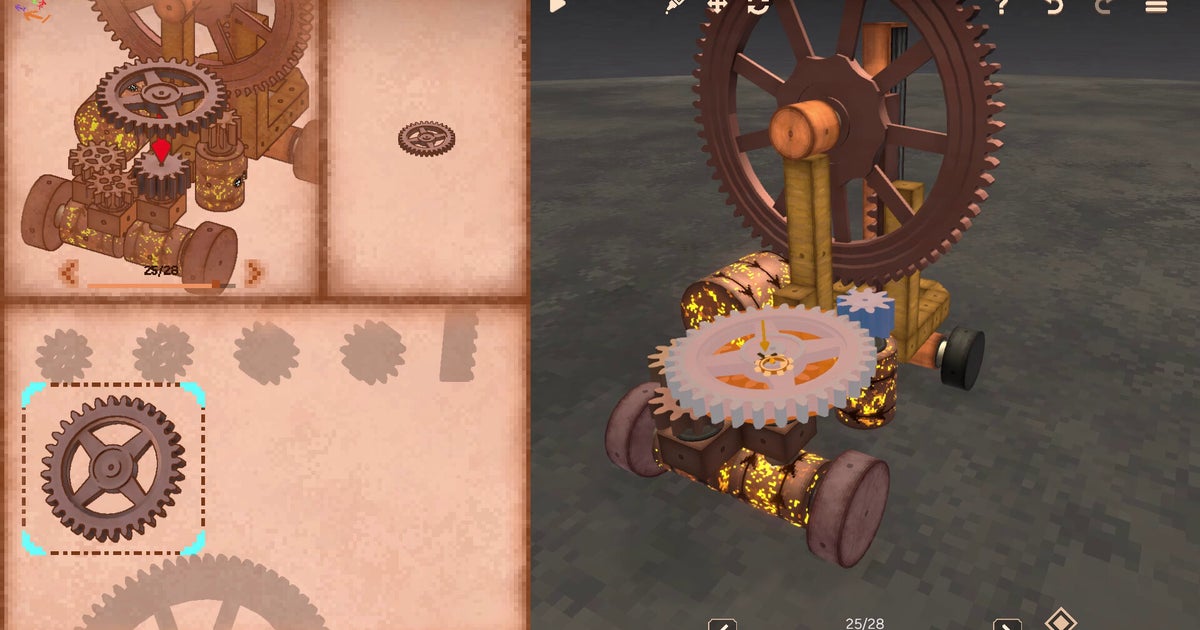
If the prospect of tracking gear tooth counts while resizing components sounds like a recipe for smoking springs in your ears, the game includes several approachability settings. The interface is inevitably complex, but players can toggle to a simpler, less intimidating HUD. Furthermore, the game features in-game instruction kits that mirror the tactile experience of pulling parts out of foam moulds and flipping through a physical manual to glue them together.
The demo is currently available on Steam, where you can begin building your own mechanical marvels—or, like me, construct a wall covered in mismatched spur gears that collapses the moment you hit play. I’ve named mine Wallter Coggins, destroyer of worlds.